 Request Proposal
Adding a New Exhaust Source to an Existing RTO: The Change-Management Review Before You Connect It
An existing regenerative thermal oxidizer (RTO) can appear to have spare capacity: the nameplate airflow may be higher than the current reading, the combustion chamber may be stable, and a new production line may only run part of the day. None of those observations alone proves that a new exhaust source can be connected safely or reliably.
The proposed tie-in changes a system rather than simply extending a duct. It can alter total airflow, VOC mass loading, oxygen conditions, inlet temperature, moisture, particulate carryover, pressure losses, combustion demand, valve cycling, fan duty, alarm logic, and the way operating data should be interpreted. The risk is not limited to an undersized oxidizer. A poorly defined connection can create unstable collection at one source, high static pressure, loss of capture, nuisance trips, an unreviewed flammability scenario, or a performance question that cannot later be explained from the data.
For plant engineers, EHS managers, project managers, and technical buyers, the practical question is: what must be checked before a new exhaust source is allowed to join an existing RTO? The answer is a documented change-management review based on the actual combined operating envelope—not a comparison of one new flow number with a nameplate value.
1. Define the change as an operating scenario, not a duct connection
Start with a one-page description of the change. Identify the new process, each pickup point, the collection method, the duct route, intended operating hours, expected start-up and shutdown sequence, and whether the source can run simultaneously with existing sources. Include what happens during cleaning, solvent changeover, upset, maintenance, bypass, and emergency stop.
This scope should distinguish between design assumptions and measured evidence. For example, a supplier data sheet may state a nominal exhaust flow, while field measurements may show a different range once dampers, hoods, doors, or process speed are considered. Treat the range and the operating combinations as the review input. Do not reduce the proposal to an average flowrate.
A useful scenario matrix lists the normal combined case, the high-flow case, the high-VOC case, start-up, low-production operation, a source isolated for maintenance, and any credible upset. It gives every discipline the same basis for review.
2. Recheck combined airflow and the collection system
The RTO is only one part of the gas path. The review should trace air from the new hood or enclosure to the stack, including branch ducts, balancing dampers, manifolds, fans, any pretreatment, the RTO inlet, heat-recovery equipment where present, and the outlet route.
For each scenario, compare the combined airflow range with the verified operating range of the existing system. Then examine the collection side: adding a branch can redistribute flow away from existing hoods if the pressure balance changes. A new source may receive too little capture flow even if the RTO itself is thermally capable of treating the gas. Conversely, forcing more flow through a common header can increase static pressure and reduce performance at multiple pickup points.
Request or create a current duct and instrument diagram, then mark the proposed connection, isolation point, balancing point, measurement locations, and control points. If current field data are unavailable, identify the gap explicitly and plan baseline measurements before final equipment selection.
Questions to answer
- What are the minimum, normal, and maximum flows at each source under representative production conditions?
- Which sources can operate together, and which are mutually exclusive?
- Does the added branch change capture performance at existing hoods or enclosures?
- What is the fan operating point before and after the tie-in, including a reasonable allowance for fouling and damper position?
- Is there a practical method to balance, measure, and document the new branch after commissioning?
3. Evaluate VOC loading, composition, and flammability together
Airflow does not describe the thermal or safety effect of a new source. The review should characterize the expected VOC constituents, concentration range, temperature, oxygen content where relevant, moisture, and contaminants that may affect ceramic media, catalysts, ducts, fans, or instruments. Separate routine process emissions from intermittent releases such as solvent flushing, manual cleaning, batch transitions, or abnormal conditions.
The important engineering input is the combined loading profile. A source with modest airflow may still materially change combustion demand or the safety envelope if its concentration peaks when other sources are active. The reverse can also be true: a high-volume, low-concentration stream may change fan and heat-balance behavior more than oxidation duty.
Flammability evaluation must be performed by qualified personnel using the actual mixture and the agreed plant safety basis. Do not assume that a low average concentration represents every operating condition. The review should confirm how the new stream is handled by the system’s existing monitoring, permissives, dilution strategy, alarm setpoints, isolation logic, and emergency response procedures. Where information is incomplete, use conservative operating controls until a qualified assessment establishes the permitted envelope.
4. Check pressure loss, fan margin, and temperature effects
New ductwork introduces pressure loss, but the bigger question is where the loss appears in the complete system. Review duct diameter, transitions, elbows, dampers, silencers, filters or pretreatment stages, access doors, and the tie-in geometry. Verify the fan curve, motor rating, variable-speed range where applicable, and the system curve for the relevant combined cases.
Also consider temperature. Exhaust temperature affects gas density, volumetric flow at the fan, condensation risk, material selection, and the thermal behavior of the RTO. A hot new source can change upstream conditions; a cooler or moisture-rich stream can change the balance differently. If the system includes heat recovery or downstream treatment, its allowable conditions belong in the review too.
Avoid treating a fan’s motor nameplate as proof of usable margin. The verified duty point, control range, vibration condition, and electrical protection settings matter. A fan operating close to its limit may not provide stable capture after a new branch is opened.
5. Review the RTO, utilities, and downstream equipment as one train
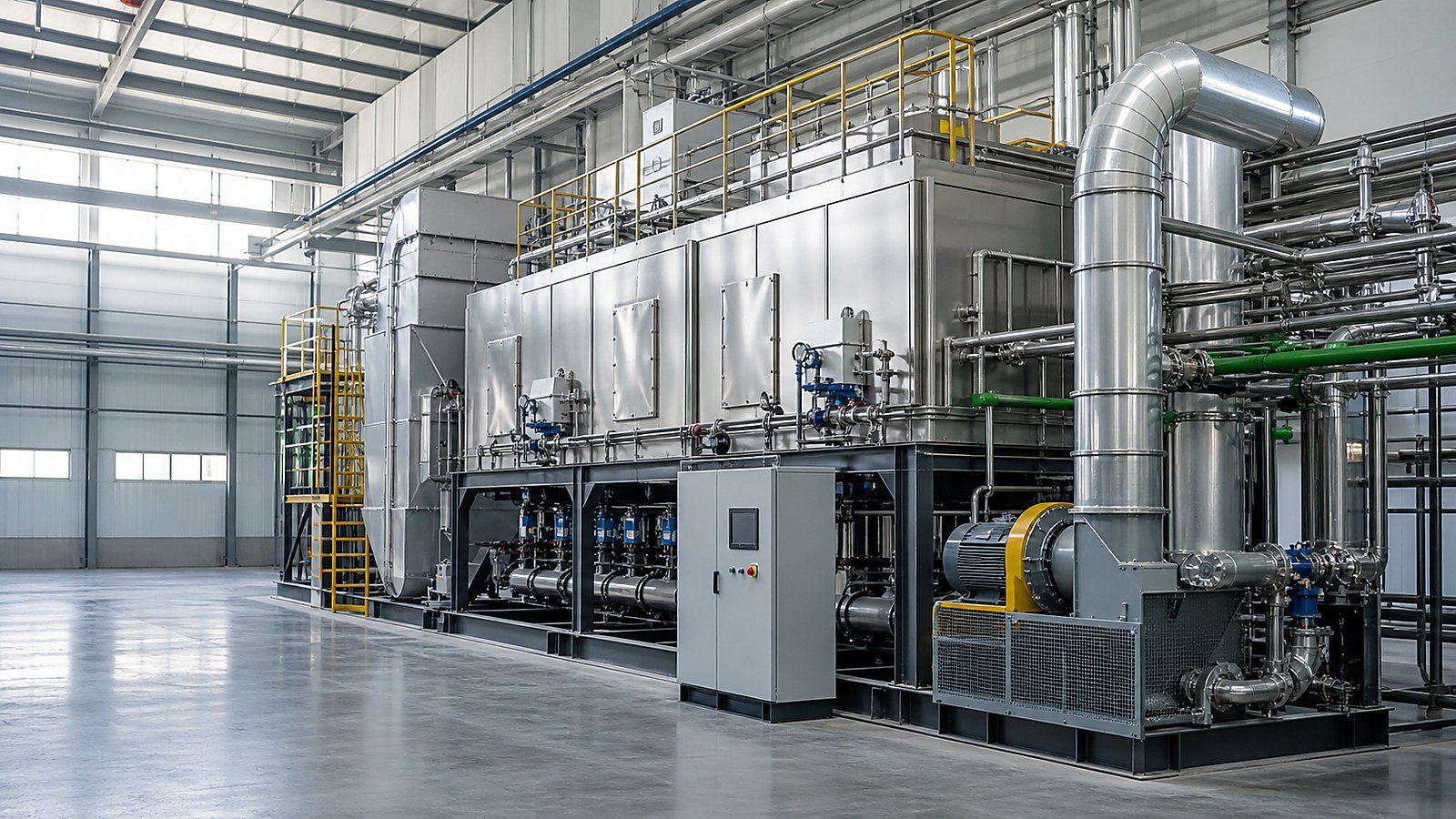
Confirm the proposed envelope against the actual configuration of the installed RTO: chamber arrangement, valve sequence, combustion system, temperature instrumentation, purge arrangement, operating logic, and any agreed limitations in the operating documentation. The review should determine whether the source changes residence-time assumptions, bed temperature balance, burner support requirement, reversal behavior, or planned maintenance window.
Utilities deserve the same attention. A source addition can change electricity demand through fan operation, fuel demand during low-loading periods, compressed-air demand for valves or instruments, and drain or condensate requirements. If dilution air, a bypass, carbon polishing, scrubber, heat recovery, or a stack fan is part of the current train, assess its capacity and control interaction as well.
This is not a promise that an RTO will meet a particular removal result or fuel consumption after a tie-in. Those outcomes depend on the verified gas profile, equipment condition, operating strategy, and applicable permit requirements. The purpose of the review is to make the constraints and verification methods clear before the connection is built.
6. Update controls, interlocks, and operating procedures before energizing the branch
An added source should appear in the system documentation and operating logic, not only on a construction drawing. Review whether the new branch requires a position feedback signal, damper interlock, flow indication, process-run signal, VOC monitor interface, temperature override, or a different start/stop sequence. Define what action occurs if the branch is opened while the RTO is unavailable, if a fan trips, if a high-temperature or high-concentration condition occurs, or if a process signal is lost.
Changes to safety-related logic must follow the plant’s management-of-change and functional-safety procedures. The team should identify who approves the logic, who tests it, and how the test record is retained. Operators and maintenance personnel need a clear procedure for normal operation, isolation, lockout, abnormal alarms, and re-start after intervention.
A practical pre-tie-in checklist
| Review area | Evidence to collect before approval | Why it matters |
|---|---|---|
| Process definition | Source list, operating modes, material/SDS information, start-up and upset description | Sets the real combined envelope |
| Airflow and capture | Field readings or a measurement plan, hood/duct layout, simultaneous-operation matrix | Protects collection performance and fan stability |
| VOC and contaminants | Representative composition/range, temperature, moisture, particulate or mist concerns | Supports thermal, materials, and pretreatment review |
| Safety basis | Qualified flammability review, existing monitor/interlock coverage, emergency actions | Prevents assumptions about peak events |
| Mechanical scope | Tie-in drawings, isolation and balancing points, supports, access, drainage | Makes the modification maintainable and testable |
| Fan and utilities | Fan/system curves, motor/control data, utility capacity check | Avoids an unworkable operating point |
| Controls and documents | Revised P&ID, cause-and-effect, procedures, training and test record | Keeps the installed change aligned with operations |
| Acceptance plan | Baseline and post-tie-in test plan, responsibilities, data log and review criteria | Provides traceable completion evidence |
7. Commission with baseline and post-change evidence
Before the physical tie-in, capture a baseline for the current system under defined production conditions. Record the operating scenario, airflow or pressure measurements at agreed points, fan speed or load where available, RTO temperatures, valve/fan status, utility readings, alarm history, and any relevant emissions-monitoring data under the site’s established method. A baseline does not eliminate engineering calculations; it makes later changes easier to interpret.
After commissioning, repeat the planned measurements with the new source isolated and with the agreed combined cases. Confirm that capture remains effective, dampers can be balanced, the fan operates within the reviewed range, controls perform as intended, and any required plant or regulatory verification is completed by the appropriate parties. Document deviations and corrective actions rather than silently redefining the acceptance condition after the fact.
For a broader introduction to early data collection, see What Are VOCs in Factory Exhaust? A First Check Before Choosing Treatment Equipment and How to Estimate Factory Exhaust Airflow for a First VOC-Treatment Inquiry. For a system-scope perspective, link to What Makes Up a Complete RTO System? Look Beyond the Main Oxidizer. Confirm final URLs before publishing these internal links.
FAQ
Can we connect a new exhaust source if the current RTO has unused nameplate airflow?
Possibly, but nameplate airflow alone is not enough. The decision should consider actual combined flow, capture balance, fan capacity, pressure loss, VOC loading, safety controls, temperatures, utilities, and the installed configuration.
Do we need to sample the new exhaust before the change?
The appropriate sampling approach depends on the process, local requirements, and engineering scope. At minimum, establish representative information on constituents, concentration range, temperature, moisture, and intermittent conditions so the change can be evaluated. Use qualified professionals for sampling and safety assessment where required.
Is a new branch damper sufficient to control the added source?
A damper may be part of the solution, but it does not prove airflow balance, safe operation, or control integration. The design should include a documented balancing and verification approach.
When should the management-of-change review be completed?
Complete it before finalizing the tie-in design and before the new source is energized. This allows duct, fan, controls, utility, and safety issues to be resolved while the modification is still practical to change.
Professional CTA
Planning to add a process exhaust source to an operating RTO or VOC-treatment line? Share the source list, operating scenarios, available airflow/VOC information, current drawings, and the proposed tie-in concept with SERNO. We can help structure a technical review scope for your project. Final equipment suitability, safety assessment, and compliance decisions should be confirmed against verified site data and applicable local requirements.
Leave a Reply